SEO E-commerce Morocco: How to Optimize Product Pages for Google, ChatGPT and AI Search
A complete guide for Moroccan e-commerce businesses that want stronger product page SEO, structured data, image optimization, internal links, and AI search visibility.
Introduction
Let's be completely honest. If you are running an e-commerce store in Morocco today, your cash flow is under siege. You are likely caught in an exhausting cycle: pouring thousands of dirhams daily into Meta, TikTok, or Google Ads, only to watch your Customer Acquisition Costs (CAC) skyrocket as your margins bleed out.
In a market heavily saturated with identical drop-shipped goods and identical ad creatives, relying solely on paid traffic is a high-risk gamble. The moment you stop feeding the ad manager, your sales flatline. There is no compounding value, no asset equity, and no long-term security.
But here is the real tragedy: when prospective buyers click your expensive ads, they land on thin, empty product pages. Pages with single-sentence descriptions, uncompressed supplier images, and zero structured data. These dry layouts fail to convert local visitors, but worse—they are completely invisible to search engines and conversational AI systems.
Today, consumers in Morocco are shifting how they discover products. They are no longer just Googling keywords; they are asking highly contextual, high-intent questions in tools like ChatGPT, Gemini, and Perplexity. To win, your store needs a premium, deeply structured product page strategy.
This masterclass breaks down how to construct highly visible, high-converting product pages built specifically for the unique realities of the Moroccan market.
1. Understand the Multilingual Search Behavior in Morocco
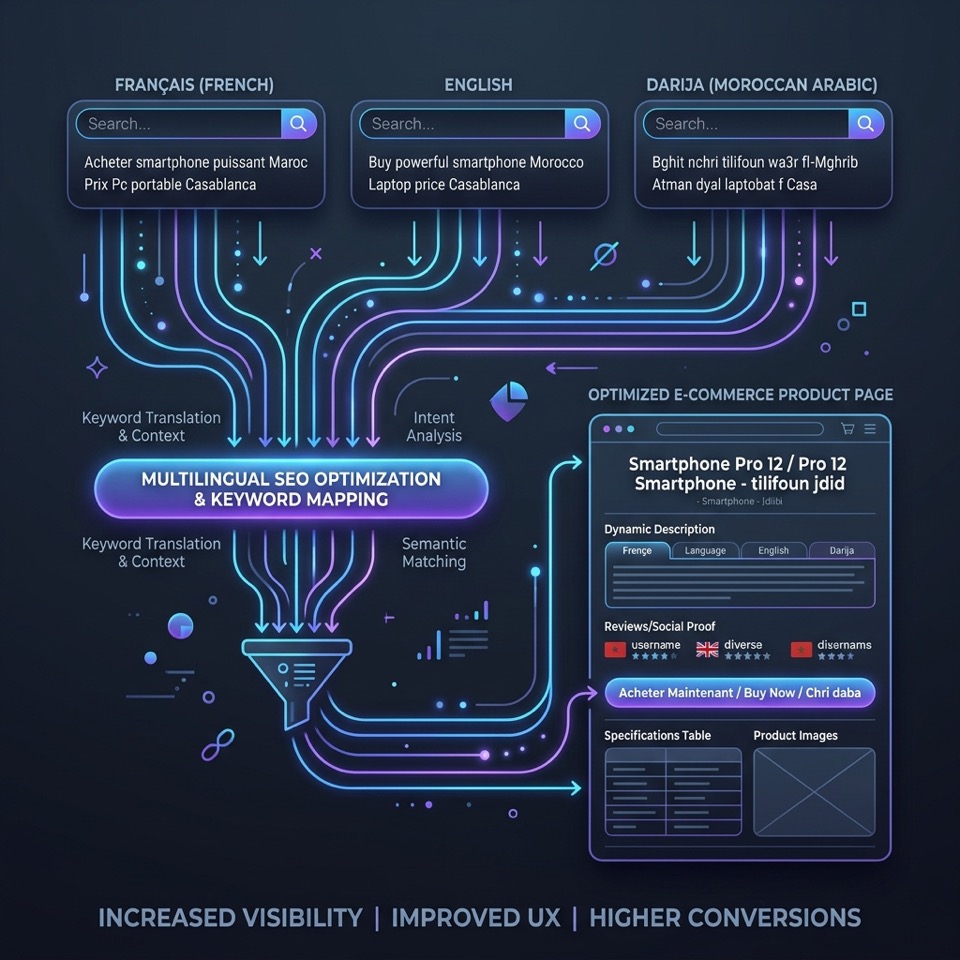
Morocco has a unique search environment. Buyers do not always search in one language. Depending on the product, audience, and intent, they may search in French, English, Arabic, or Darija written in Latin characters.
If your product copy only targets a single formal language, you are completely blind to over 50% of the active organic search intent. Consider the vast search matrix for a single organic skincare product:
| Search Intent | French Query | English Query | Darija / Local Query |
|---|---|---|---|
| Culinary argan oil | huile d’argan alimentaire Maroc | organic culinary argan oil Morocco | zit argan makla / zit argan akil |
| Cosmetic argan oil | huile d’argan cheveux visage | argan oil for hair and skin | zit argan che3r / zit argan lwajh |
| Moroccan caftan | caftan moderne velours soie Fès | luxury velvet Moroccan caftan | qaftan maghribi mobra dial fas |
| Local delivery | livraison caftan Casablanca | caftan delivery Morocco | livraison casa / chri f casa |
This does not mean your product page should be overloaded with keywords in every language. That would make the copy look unprofessional.
The best approach is structural keyword zoning. Use one main language for the core page structure. For example, if the page is in English, keep the H1, product description, and main sections in English. Then include French, Arabic, or Darija variations in natural places such as FAQ questions, product attributes, image alt text, category descriptions, search-friendly filters, internal linking anchors, customer support text, delivery information, and payment information.
2. Build Product Pages as Complete Information Hubs
A product page should not only say what the product is. It should explain why the product matters, who it is for, how it works, what makes it different, and why the buyer can trust it.
Search engines and AI systems understand pages through entities, facts, attributes, and relationships. The more complete and structured your page is, the easier it becomes for Google and AI search engines to understand your product.
A strong Moroccan e-commerce product page should include:
- A descriptive product title
- A short persuasive introduction
- Key features and benefits
- Technical specifications
- Product use cases
- Delivery information
- Payment options
- Trust signals
- Product images with optimized alt text
- Frequently asked questions
- Related categories or related products
- Product schema markup
3. Use Descriptive Product Titles
Many e-commerce stores use product titles that are too short.
Weak title: Argan Oil
This title is too generic. It does not explain the product type, size, origin, use case, or quality.
Better title: Premium Extra-Virgin Culinary Argan Oil 250ml – Cold-Pressed in Taroudant, Morocco
This title is stronger because it includes:
- Product type
- Quality level
- Usage
- Size
- Extraction method
- Local origin
Weak title: Green Caftan
Better title: Emerald Green Moroccan Caftan – Handmade Silk Velvet with Traditional Sfifa
A descriptive product title helps users, Google, and AI search systems understand the product faster.
4. Write a Strong Product Introduction
The introduction should quickly answer three questions:
- What is the product?
- Who is it for?
- Why should someone buy it?
Example for argan oil
Sourced directly from the UNESCO-protected argan biospheres of Taroudant, our extra-virgin culinary argan oil is slowly cold-pressed by local women's cooperatives. Every drop delivers an intense, toasted nutty aroma and a smooth golden texture, packing your gourmet dishes with rich Vitamin E, plant sterols, and healthy monounsaturated fats.
Example for a Moroccan caftan
Wrap yourself in timeless Moroccan royalty. Hand-embroidered over forty hours by master artisans in Fez, this emerald green caftan seamlessly merges an elegant modern tailored silhouette with the unmatched weight of Italian silk velvet. Adorned with authentic gold silk sfifa and hand-woven aakad closures, it stands as an enduring masterpiece for weddings and prestigious family occasions.
The introduction should be clear, useful, and specific. Avoid generic copy like: High-quality product at the best price.
5. Turn Features into Benefits
Many product pages only list features. A better product page connects each feature to a buyer benefit.
Example for culinary argan oil
| Feature | Benefit |
|---|---|
| Mechanical First Cold-pressing | Retains 100% of the natural tocopherols and essential fatty acids that heat-extracted oils destroy. |
| Origin from Taroudant (UNESCO Biosphere) | Builds authenticity, builds local Moroccan identity, and guarantees pristine terroir. |
| Dark glass bottle | Protects the delicate extra-virgin oil from light degradation and preserves absolute freshness. |
| 250ml size | Practical format for daily kitchen finishing oil use |
| 100% pure organic toasted kernels | Reassures buyers that the product is completely undiluted, clean, and authentic. |
Example for a Moroccan caftan
| Feature | Benefit |
|---|---|
| Master Handmade embroidery (Tarz Fez) | Gives the product an exquisite, durable artisanal finish machine replication can never match. |
| Premium Italian Silk velvet fabric | Creates a luxurious look, rich color depth, and exceptionally elegant heavy drape. |
| Authentic Gold Silk sfifa | Reinforces Moroccan cultural authenticity and reinforces prestige aesthetics. |
| Hand-woven gold aakad closures | Adds traditional handcrafted details and highly premium luxury finishing. |
| Adjustable hidden inner belt | Allows customized waist styling for comfort and a tailored silhouette. |
6. Add Technical Specifications in a Clean Table
Technical specifications are extremely important for e-commerce SEO. They help buyers compare products and allow search engines to extract structured product attributes.
Do not hide specifications inside long paragraphs. Use clean HTML tables.
Culinary Argan Oil Specifications
| Attribute | Details |
|---|---|
| Product Type | Extra-virgin culinary argan oil |
| Usage | Food finishing, salads, amlou, gourmet Moroccan dishes |
| Extraction Method | First mechanical cold-pressing |
| Origin | Taroudant, Souss-Massa, Morocco |
| Volume | 250ml |
| Packaging | UV-resistant dark glass bottle |
| Ingredients | 100% pure organic toasted argan kernels |
| Additives | No preservatives, zero artificial additives, GMO-free |
| Storage | Store in a cool, dry place away from direct sunlight |
Moroccan Caftan Specifications
| Attribute | Details |
|---|---|
| Product Type | Moroccan caftan (Single-piece luxury cut) |
| Style | Modern luxury caftan |
| Color | Emerald green |
| Fabric | Premium Italian silk velvet |
| Embroidery | 100% handmade traditional embroidery (Tarz Fez) |
| Details | Pure gold silk Sfifa and handmade Aakad closures |
| Occasion | Weddings, engagements, prestigious family events |
| Origin | Fez, Morocco (Artisanal Workshop) |
| Care Instructions | Professional dry clean only |
7. Optimize for AI Search and Generative Engine Optimization
Traditional SEO focuses on ranking in search results. AI Search optimization focuses on making your content easy for answer engines to understand, extract, and cite.
Tools like ChatGPT, Gemini, and Perplexity look for clear answers, reliable entities, structured information, and specific details.
Entity Clarity
Mention the important entities connected to your product.
For culinary argan oil, relevant entities may include:
- Argan oil
- Morocco
- Taroudant
- Souss-Massa
- Cold-pressed extraction
- Culinary oil
- Amlou
- Moroccan cuisine
- Vitamin E
- Toasted argan kernels
For a Moroccan caftan, relevant entities may include:
- Moroccan caftan
- Sfifa
- Aakad
- Fez craftsmanship
- Moroccan wedding
- Handmade embroidery
- Silk velvet
- Traditional Moroccan fashion
Structured Q&A
Add a visible FAQ section to answer buyer questions directly. A visible FAQ is useful for SEO, AI Search, and conversion because it answers real buying objections.
Culinary argan oil is made from toasted argan kernels and is mainly intended for food use. For skin and hair, cosmetic argan oil made from untoasted kernels is usually more appropriate.
Yes, the caftan includes handmade Moroccan details such as traditional embroidery, sfifa, and aakad closures, depending on the specific model.
If Cash on Delivery is available, mention it clearly near the add-to-cart button and inside the FAQ section.
8. Add Local Trust Signals for Morocco
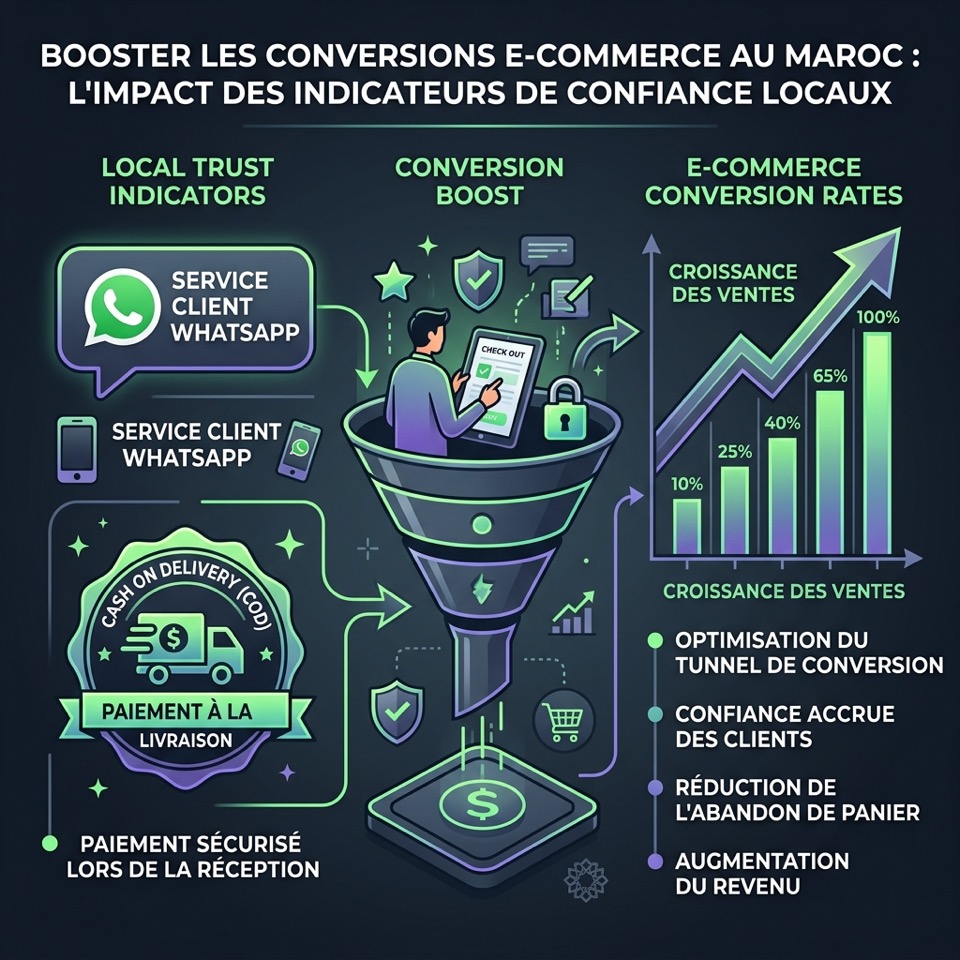
Trust is one of the biggest conversion factors in Moroccan e-commerce.
Many customers want reassurance before ordering. They may want to know if the store is real, if delivery is reliable, if Cash on Delivery is available, and whether they can speak to a real person before buying.
Your product page should include local trust signals such as:
- Cash on Delivery availability
- WhatsApp support
- Delivery cities
- Return policy
- Exchange policy
- Customer reviews
- Real product photos
- Secure checkout
- Business contact information
Example trust message: Paiement à la livraison disponible partout au Maroc. Livraison rapide à Casablanca, Rabat, Marrakech, Tanger, Agadir, Fès et autres villes.
Example WhatsApp CTA: Need help before ordering? Contact us on WhatsApp for product details, size advice, delivery information, or order confirmation.
For the Moroccan market, WhatsApp is not just a support tool. It is often part of the conversion funnel.
9. Optimize Product Images for SEO and Speed
Product images have a direct impact on SEO, user experience, and conversion.
Large, uncompressed images can slow down product pages, especially for mobile users. Slow pages increase bounce rates and reduce conversions.
Use these image SEO best practices:
- Use WebP or AVIF format when possible
- Compress images before uploading
- Use descriptive file names
- Add clear alt text
- Include product name, color, material, or use case
- Avoid uploading supplier images with random file names
- Use original product photos when possible
Bad file name: IMG_8837.jpg
Good file name: premium-culinary-argan-oil-250ml-morocco.webp
Bad file name: product-final-new.png
Good file name: 'emerald-green-caftan-silk-velvet.webp'
Example alt text:
- Premium culinary argan oil 250ml cold-pressed in Morocco
- Emerald green Moroccan caftan with handmade sfifa and silk velvet fabric
10. Add Product Schema with MAD Currency
Product schema helps Google understand your product details, including name, image, description, SKU, price, currency, availability, and brand.
For Moroccan e-commerce websites, make sure your pricing uses MAD as the currency.
<script type="application/ld+json">
{
  "@context": "https://schema.org/",
  "@type": "Product",
  "name": "Premium Extra-Virgin Culinary Argan Oil (250ml)",
  "image": [
    "https://example.com/images/premium-culinary-argan-oil-250ml-morocco.webp"
  ],
  "description": "Premium extra-virgin culinary argan oil cold-pressed in Taroudant, Morocco. Fully ONSSA approved and USDA Organic certified. Ideal for Moroccan dishes, salads, amlou, and gourmet cooking.",
  "sku": "ARG-CUL-250",
  "brand": {
    "@type": "Brand",
    "name": "Your Brand Name"
  },
  "offers": {
    "@type": "Offer",
    "url": "https://example.com/products/premium-culinary-argan-oil-250ml",
    "priceCurrency": "MAD",
    "price": "180.00",
    "availability": "https://schema.org/InStock",
    "itemCondition": "https://schema.org/NewCondition",
    "seller": {
      "@type": "Organization",
      "name": "Your Store Name"
    }
  }
}
</script>
Product schema does not replace good content, but it helps search engines understand your page more accurately.
11. Improve Internal Linking
Internal links help users and search engines discover related content.
On product pages, link to:
- Related categories
- Similar products
- Buying guides
- Size guides
- Delivery policy
- Return policy
- Blog articles
- Brand pages
Example internal links:
12. Product Page SEO Checklist for Moroccan E-commerce Stores
Use this checklist before publishing or updating any product page:
| SEO Element | Status |
|---|---|
| Descriptive product title | Required |
| Clear product introduction | Required |
| Features and benefits | Required |
| Technical specifications table | Required |
| Product images compressed | Required |
| WebP or AVIF images | Recommended |
| Descriptive image alt text | Required |
| Product schema added | Required |
| MAD currency used in schema | Required |
| Cash on Delivery information | Recommended |
| WhatsApp CTA | Recommended |
| Delivery cities mentioned | Recommended |
| FAQ section added | Recommended |
| Related categories linked | Required |
| Related products linked | Recommended |
| Mobile speed tested | Required |
| Meta title optimized | Required |
| Meta description optimized | Required |
13. Recommended Product Page Structure
A strong product page structure for Moroccan e-commerce should look like this:
- Product title
- Product images
- Price and availability
- Add to cart button
- Cash on Delivery and delivery information
- WhatsApp support button
- Short product introduction
- Key benefits
- Technical specifications
- Use cases
- Product details
- Reviews or testimonials
- FAQ section
- Related products
- Related categories
- Product schema
14. Example Optimized Product Page Copy
Product Title
Premium Extra-Virgin Culinary Argan Oil 250ml – Cold-Pressed in Taroudant, Morocco
Short Description
Discover authentic Moroccan culinary argan oil made from carefully selected toasted argan kernels and cold-pressed in Taroudant. With its rich nutty flavor and smooth golden texture, this oil is ideal for salads, couscous, grilled vegetables, amlou, and traditional Moroccan recipes.
Key Benefits
- Cold-pressed to preserve natural flavor and nutritional value
- Made from 100% pure toasted argan kernels
- Ideal for Moroccan dishes, salads, and gourmet cooking
- Produced in Morocco using traditional expertise
- Packaged in a dark glass bottle to protect freshness
Technical Specifications
| Attribute | Details |
|---|---|
| Product Type | Culinary argan oil |
| Volume | 250ml |
| Origin | Taroudant, Morocco |
| Extraction | Cold-pressed |
| Ingredients | 100% toasted argan kernels |
| Usage | Food and cooking |
| Packaging | Dark glass bottle |
| Storage | Keep away from heat and sunlight |
Conclusion
E-commerce SEO in Morocco is still a major opportunity. Many online stores depend almost entirely on paid ads while their product pages remain thin, slow, and poorly structured.
That creates an advantage for brands that invest in organic visibility early.
By building detailed product pages, targeting multilingual search behavior, adding structured data, improving image performance, including local trust signals, and answering buyer questions clearly, Moroccan e-commerce businesses can create long-term SEO assets that generate traffic and sales over time.
Paid ads can bring short-term visibility. Strong SEO builds a compounding acquisition channel.
Need Help with E-commerce SEO in Morocco?
I’m Othmane Outaghza, a Technical SEO Consultant and AI Search Specialist based in Morocco.
I help e-commerce and service businesses improve technical SEO, product page optimization, structured data, internal linking, image SEO, and visibility across Google, ChatGPT, Gemini, and Perplexity.
Whether your store is built on Shopify, WooCommerce, YouCan, or a custom platform, I can help you identify technical issues, improve product pages, and build a stronger organic growth strategy.
Need help with e-commerce SEO in Morocco?
Get a practical SEO and AI search visibility audit for your product pages, category pages, structured data, and internal linking.
Request an SEO and AI search visibility auditOthmane Outaghza
Technical SEO Consultant & AI Search Specialist
Othmane Outaghza helps e-commerce and service businesses improve technical SEO, structured data, product page SEO, and AI search visibility.